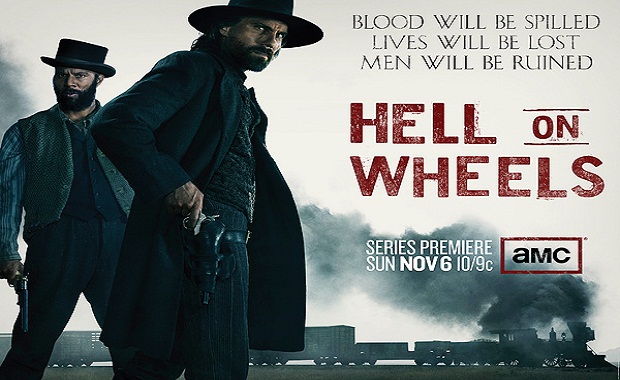

This is not a review for the pilot episode of Hell on Wheels. You see because I don’t think I could barely muster up more than 150 words about that initial offering. At the pilot stage, Hell on Wheels is dull, sloppy, clunky and generally trying to do way too many different things without accomplishing any of those things successfully. Wheels simultaneously wants to be a sweeping historical epic that retells our country’s past in compelling ways (again, it wants to do this not, it doesn’t accomplish them), a straightforward revenge tale, a story about a strong-willed black man surviving in the post-Civil War era and ten other things that I don’t have the energy to recollect. The pilot makes the mistake that so many wannabe-great dramas are doing these days in that it begins with a dozen disparate stories with the hopes of covering as much ground as possible, only unlike Boardwalk Empire or Game of Thrones, none of those disconnected threads is particularly engaging here. I’m not going to stop watching Hell on Wheels, but you knew that already. The short point is that the pilot episode isn’t that good and it’s actually quite tepid.
But I’d actually like to use Hell on Wheels to further address something I apparently just can’t stop talking about: AMC’s brand. I wrote about the cable network’s struggles around the time that The Killing was stinking up the airwaves and I also addressed some of AMC’s issues last week in a short piece for In Media Res. You should obviously read both of those pieces, but I’ll probably be addressing similar concepts and points here, if only because AMC continues to make the same mistakes with its programming and those mistakes just bother me. I want television to be good and I want television networks to be smart and successful.
Surely you all know about AMC’s issues in 2011. Most of these issues are self-inflicted and probably could have been avoided, which makes the network’s year so curious (and frustrating) for folks like me who are interested in this kind of thing. Coming into 2011, AMC was riding pretty high. Mad Men just finished its best season, anticipation for Breaking Bad couldn’t be higher and The Walking Dead gave them their first legitimate mainstream hit. Sure, Rubicon failed to catch on with audiences, but the critical acclaim that came in the second half of the series’ only season was a valuable addition to AMC’s brand image and equity.
Of course, this year has been a mess, particularly in the public relations department. AMC let the contract negotiations with Mad Men mastermind Matthew Weiner become way too public and even after the two sides came together, the brokered deal had a rippling effect on the rest of AMC’s decisions. Network brass asked The Walking Dead and Frank Darabont to take a major budget cut for its second season, something that certainly played a role in the network’s second way-too-public dispute with a showrunner. Darabont was likely fired. Then AMC found themselves stuck in yet another PR disaster when it was leaked that they were being a bit skimpy on costs and episode orders with Vince Gilligan and Lionsgate during negotiations to keep Breaking Bad on the air for a final season. Throw in the fact that AMC decided not to pick a single one of the many pilots they had in the works, and the narrative quickly became that AMC is cheap, way too cheap in fact. It’s warranted. They don’t have the additional revenue that HBO does, but asking your own financial success (Dead) to take a substantial budget cut plays like bad business to me.
And this is all skirting over the rain-drenched elephant in the room: The Killing. There’s no real need to rehash all the specific problems that The Killing had in its first season (because there were oh so many), but it is important to recall the things that Veena Sud kept trumpeting in all her blindly arrogant and arguably ignorant soundbites in the days and weeks after the series’ first season ended. On more than one occasion, Sud put her series and its supposed “twists” alongside television royalty such as The Sopranos, Mad Men and Breaking Bad. Sud wrongly assumed that people loved The Sopranos because of its final-episode twist, stupidly conflated Mad Men’s purposeful pacing with her series’ aimless plodding and apparently thought that the “WTF!” tweets reserved for Breaking Bad meant exactly the same thing as all the “WTF.” Tweets reserved for her series.
The point to all of this (and I swear there is one) is this: I think AMC assumes that if it continually tells people who great they are and how “original” their stories are, everyone will just believe them. Both The Killing and Hell on Wheels feel like empty, failed attempts of trying to meet some “quality television” checklist that everyone has in their head. Dozens of storylines, many of them not connected? Check. “Slow” (but not purposeful) pacing? Check. Lots of diegetic dialogue dedicated to telling the audience how complicated and conflicted its lead characters are? You’re damn right. Somewhat novel settings that embrace supposedly new wrinkles on old genres? Yeah dog. In the case of The Killing in particular, ridiculous, illogical twists for twists sake? Oh yeah. Welcome to quality television-by-numbers.
The thing is, for your programs to truly be “quality”* or “great,” to even be in the conversation with the likes of The Sopranos, Mad Men and Breaking Bad, you actually have to fill the world with engaging characters and compelling storytelling. Most television is formulaic, I get that. Even in all their greatness glory, HBO still has a formula for how it approaches stories, particularly in first seasons. The formula is successful as hell, but it’s still a formula. However, HBO’s great series still take that formula and put their own, interesting twists on it. And when they don’t? We take them down for it. There’s a reason why people have had trouble warming up to Boardwalk Empire over the first season and a half.
*Obviously “quality” and “great” are terms and ideas that are in the eyes of the beholder. However, if we are following Sud and AMC’s assumptions about what, in fact, does make up quality television or using general analytical tools, it’s still fairly obvious that The Killing and Hell on Wheels fail to meet the minimum requirements. They’re flimsy posers.
But AMC, The Killing and Hell on Wheels are way worse than HBO and Boardwalk Empire. AMC wanted us to think it was reimagining the single-case detective story. It was not. AMC has already had success by going the historical route, but needed its own western as well. That’s all fine and good, but when you’re a cable network making a western, you know you’ll be compared to Deadwood and if you don’t even make an effort to do something, anything different – or at all, really – then the comparisons are going to be even harsher.
The Killing and Hell on Wheels make so many assumptions about the audience and about quality television. Both series assume that if they provide obvious generic markers and clear “quality” markers, the audience will embrace them full-force, no questions asked. They assume that quality television is more about the wrapping paper, the bells and the whistles than what is actually inside the giftbox itself.
And that makes them perfectly placed on AMC’s schedule. AMC as a whole makes the same ignorant assumptions about how great television networks are created and cultivated. You don’t get to sort of luck into two great series (Mad Men and Breaking Bad), have one mainstream success (Walking Dead) and then call it day, hold on to your quality television crown and watch the profits come in. I don’t know personally, but I’m guessing that running a television network and continually coming up with great ideas is a damn difficult job to have. But you have to embrace those difficulties, those challenges and try to come up with something that actually reifies your catchy marketing slogans and brand promises. Otherwise, your customers (read: the audience) will stop trusting you and lose any identification with your product. When HBO fails, it’s almost always because they take weird risks that are actually too niche or narrow for even their refined audience. AMC hasn’t really taken a risk lately and they spent 2011 cutting the risks that previously paid off down.
HBO is a lot of things, but it’s not lazy. FX is not lazy. Showtime is predictable, but still not lazy. AMC, if you want a seat at the quality television table, you have to do better than this. Stop telling us what you are and actually show it to us.


Leave a Reply